Cal Poly Baseball Celebrates 25th Anniversary of Baggett Stadium
2/25/2026 12:15:00 PM | Baseball
SAN LUIS OBISPO, Calif. — Scott Neal was at the plate with a 3-2 count.
The game was tied. With one out. In the 12th inning. Against the No. 11 team in the country. A College World Series finalist a year earlier.
The bases were loaded. The pitch was in the dirt. Neal did not chase. He let the pitch go by.
Kyle Wilson, who doubled leading off the inning, trotted home from third base and Coach Ritch Price’s Mustangs rushed the field to celebrate a 6-5 victory over Stanford on January 21, 2001, in the first game ever to be played in Baggett Stadium after 28 seasons in SLO Stadium on the other side of town.
“That was pretty intense,” Neal said of the at-bat. “I just wanted to make sure it was something I could hit.”
“There’s no question it’s the greatest game I’ve ever coached in,” added Price, who went on to coach at Kansas for 20 seasons before retiring in 2022.
“I’ll be honest. When we won that game, I had tears in my eyes,” said catcher Robin Baggett. “I don't have tears in my eyes very often, but that was special.”
Baggett and other Cal Poly baseball alumni will revisit the moment on Thursday night when the Mustangs open Alumni Weekend with the first of four games against USC inside Baggett Stadium at 6 p.m. Baggett has the honor of throwing the ceremonial first pitch.
Despite chilly temperatures which dipped into the mid-40s by the end of the game 25 years ago, the historical contest was witnessed by 3,110 fans.
The pregame 30-minute dedication ceremony featuring the official first pitch by Mike Krukow to Baggett, who then threw to second baseman Dave Oliver — “I just didn’t want to one-hop it,” said Baggett — was held despite the fact construction of the stadium wasn’t quite finished.
The scoreboard was not installed for another month. The press box was completed a couple months later, a temporary sound system was in place, the padded backstop and bat racks had yet to arrive from the manufacturer and there were no lockers in the locker room.
Nevertheless, the game was played and most of the fans who remained for all 12 innings were witnesses to all the “firsts” established in the inaugural Baggett Stadium game:
• Cal Poly’s Jared Blasdell delivered the first pitch to Stanford’s Brian Hall at precisely 1:03 p.m. It was fouled off to the right side behind first base.
• Mustang designated hitter Bryan Gant produced the first hit in the brand new facility, a single to left field in the bottom of the first inning. Gant finished with three hits in the game.
• Center fielder Jason Barringer scored the first run of the stadium’s history in the first frame, coming home from third base on a passed ball.
• The first RBI in Baggett Stadium came courtesy of a two-run triple by third baseman Chris Martinez, highlighting Cal Poly’s four-run first-inning rally.
• There were no home runs in the 2001 season opener for both teams. The honor of hitting the first four-bagger in Baggett Stadium went to San Diego’s Josh Harris, a solo shot in the seventh inning on Feb. 2, the fifth game to be played in the facility. First Mustang to homer at Baggett Stadium was second baseman Kevin Tillman in Game 7, a one-out solo shot to right field in the second frame versus the Toreros on Feb. 4.
• The winning pitcher was Nathan Choate, who currently is head baseball coach at Washington State after four seasons as head coach at Loyola Marymount, while the loss was charged to Stanford reliever John Hudgins. The two teams combined to use 13 pitchers in the game.
• Price, who coached the first six of his eight Cal Poly baseball teams at SLO Stadium, earned his first Baggett Stadium victory while Mark Marquess suffered the first loss of the facility. Marquess, head coach of the Cardinal for 41 seasons before retiring in 2017 with a 1,627-878-7 career record, passed away last month at age 78.
“Baggett Stadium was a game changer for the baseball program, moving up from Division II to the Division I level,” said Price. “When I was putting the schedule together that year for our first game at Baggett Stadium, I wanted to open with the best Division I program in the country. I called my good friend and Hall of Fame coach at Stanford (Marquess) and asked him to play the opening game at Baggett Stadium.
“I remember the fans standing all over the concourses and on the hillsides to get a great view of the stadium and game,” Price added. “It was an incredible victory, and to do it in front of over 3,000 people gave me goosebumps. After the game, they took a picture of Robin and myself on the field arm in arm, and Robin had tears running down his face. That picture has been displayed in my office for over 30 years.”
The game almost never took place. In fact, in 1979, there was mention of dropping baseball at Cal Poly.
“President (Warren) Baker had just become the new president, and before him was a proposal to eliminate baseball,” said Baggett. “I heard about that, and of course I was very concerned. I set up a meeting with myself, Baker and Mike Krukow. We sat down and basically told him, ‘You just can't get rid of baseball. Baseball is a sport that Cal Poly can compete at nationally.’ ”
The group came up with a solution.
“We worked out an agreement that (the university) would fund the personnel and that Mike and I would raise the money to fund the operational side of the team,” Baggett said. “We did that for 10 years. We were running golf tournaments and other fundraisers, paying half as much as the university was paying.”
Next for Baggett was the Performing Arts Center on campus. Baggett was involved in the fundraising and secured the lead gift that made that project reach a successful conclusion in 1995.
Baggett then turned his focus into another arena.
“I went to the president and said, ‘You know, we need to build a sports complex on campus. And as a part of that, we need to bring baseball and softball back to Cal Poly, and also provide fields for the students.’ ”
With $10.9 million in private funding secured — more than $5 million through donations and gifts in kind, $4.9 million through student fees and $820,000 from University Union reserves — the 47-acre Cal Poly Sports Complex featured Baggett Stadium for baseball, Bob Janssen Field for softball, six natural grass softball/soccer venues on the lower field and three artificial turf soccer fields on the upper portion of the facility.
“I was the one in charge of raising the money for the sports complex. And it worked out, right?” Baggett asked.
Indeed. Because of “sweat equity” as Baggett describes it, the baseball stadium was named after the man who played in Cal Poly’s first-ever game at SLO Stadium — which by the way was a 4-0 shutout against No. 5-ranked Santa Clara on May 16, 1971 — and caught two no-hitters at the old campus diamond on land currently occupied by engineering buildings.
Those pitching gems, by the way — Dean Treanor on March 26, 1970, and Les Ohrn on May 8, 1971, both versus Cal Poly Pomona — are the last complete-game no-hitters Cal Poly has recorded.
Stanford erased a 5-3 deficit with two runs in the ninth inning — a two-out two-run double by Chris O’Riordan off Mustang standout Kevin Correia — to force extra frames. Cal Poly came close to ending the game in the 10th, but Sam Herbert, trying to score from second base on a grounder to left field, was thrown out by Hall.
Cal Poly’s starting lineup featured Sheldon at first base, Tillman at second base, Scott Anderson at shortstop, Martinez at third base, Neal in left field, Barringer in center field, Phil Thompson in right field, Keith Anderson behind the plate and Blasdell on the mound. Gant was the designated hitter.
The umpiring crew included former Mustang outfielder Dan Marple calling balls and strikes. Two other former Mustangs — Mark O’Brien and Tom Kunis — were members of the coaching staff under Marquess for Stanford — O’Brien as first-base coach and Kunis as pitching coach.
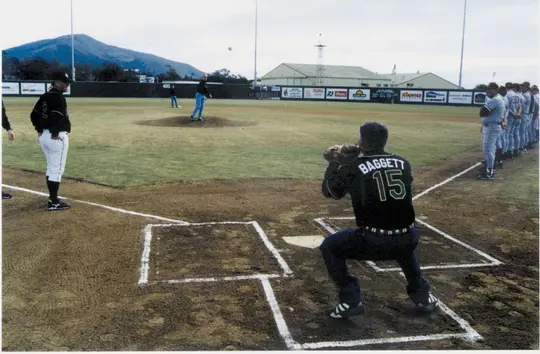
“It was emotional, really, because (a baseball field) is where so many of my lessons in life came from,” Baggett said. “This is where I learned about being a team player, about success and winning.
“I wish I was out there playing again,” he added.
John McCutcheon, hired as Cal Poly’s director of athletics in 1992 a few months after students passed a referendum to move the university to NCAA Division I, also was instrumental in the Cal Poly Sports Complex project.
“McCutcheon was the architect behind the entire process,” said Price. “It would have never happened without his vision. I got to help plan the outfield fence, batting cages, Bermuda grass Infield and raised the funds for the clubhouse lockers, furniture, field tarp, etc.”
Price recalled a fund-raising trip to Newport Beach to visit former Mustang pitcher Jim Newkirk.
“Jim loved Cal Poly baseball and was still in the Top 10 for lowest ERA in school history,” Price said. “So he invites me to his golf course at Newport Beach Country Club and, as we’re walking down the first fairway, he says to me, ‘So how much is this round of golf going to cost me?’
“So I explain to him that I’ve got a presentation for you when we’re done. Jim says that’s fine, how much do you need? So I tell him that our fundraiser wanted me to ask you for a $100,000 donation to help finish the clubhouse, batting cages, etc. He doesn’t take 10 seconds and asks me if he can put it on his American Express Card. He said that would mean four first-class round trip tickets overseas for he and his wife.”
One call a short time later and the deal was done.
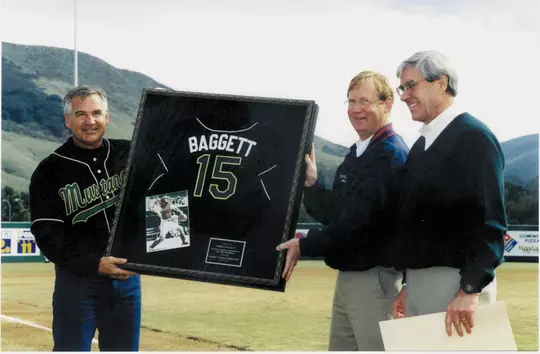
Baggett was Cal Poly’s catcher in the early 1970s. A two-time all-conference and Most Valuable Player, he compiled a career fielding percentage of .990, did not allow a passed ball his senior year (1971) and threw out over 70 percent of would-be base runners. He also was very involved in the student body, serving as the Associated Students, Inc., president his senior year.
Following graduation with honors in business, Baggett chose a career in law, attending University of California, Hastings College of the Law. Baggett was an editor of the Law Review, clerked for the California Supreme Court and the United States District Court in San Francisco and has been a longtime supporter of Cal Poly athletics.
He served as Co-Chair of the Capital Campaign, which raised over $5 million for the project, and was inducted into the Cal Poly Athletics Hall of Fame in 1998. In 2024, he was inducted in the Salinas Valley Sports Hall of Fame, where he was born and raised. Baggett practiced law for 40 years with his San Luis Obispo law firm, Sinsheimer, Schiebelhut & Baggett, where from 1993-2001 he served as General Counsel to the NBA’s Golden State Warriors.
Currently, he devotes his primary working efforts in the wine industry, owning Alpha Omega Winery in the Napa Valley and Tolosa Winery in San Luis Obispo County. Baggett is the current Chair of the California Wine Institute (representing over 1100 wineries), past chair and board member of the Napa Valley Vintners (representing over 550 wineries), chair of the Napa County Land Trust and past chair and board member of Festival Napa Valley.
Baggett, who has two children, Kelly and Scott, currently resides with his wife, Michelle, in Rutherford and Pebble Beach, where he enjoys his passion for golf. Robin and Michelle spend a substantial amount of their time with philanthropic efforts, raising millions of dollars for youth wellness projects.
“Robin represents everything that is good about Cal Poly and Cal Poly Baseball,” said Price. “He was a great player, very successful in his career, and continues to give back to his alma mater. I love the man and appreciate everything he’s done for the athletics department and the university over the years.”
Baggett shared some other memories of his longstanding association with Cal Poly Baseball.
• The three players involved in the 2001 ceremonial first pitch — pitcher Krukow, catcher Baggett and second baseman Oliver — all are in the Cal Poly Athletics Hall of Fame. “Oliver was always in position and always there. All I had to do was put the ball somewhere near the bag and he’d get them out. I attribute a lot of my success in throwing people out to Dave. He was good, one of the best second basemen we’ve ever had at Cal Poly.”
• The legendary Augie Garrido coached at Cal Poly from 1970-72, compiling an 86-62-1 record, including a 39-11-1 mark in 1971. He also coached at San Francisco State, Cal State Fullerton, Illinois and Texas, retiring in 2016 with 1,975 career victories. He passed away in March 2018.
“Number one, Augie is a winner. He wants to win,” said Baggett. “Augie was a master of putting the right talent together from recruiting. I think his biggest attribute was recognizing talent and how to put it together to formulate a winning team.
“And number two, he knew how to win a game. He'd figure out how to go to the end. We had the highest winning percentage of any team at Cal Poly (.775 in 1971). We had 12 shutouts that year. Our team ERA was 1.98 (by contrast, the Cal Poly record for lowest ERA in 31 Division I seasons is 3.40). We didn’t give up 90 feet. Don’t make an error and don’t let somebody steal on you.”
• “One other thing with Augie, we had the other team’s signs by the second inning. I knew when they were going to try to steal. I’d call a pitchout and run into the dugout. It was over.”
• Baggett called every pitch when he played at Cal Poly in 1970 and 1971. “I was the only catcher he let call every game that I played. He never called a pitch. And then somebody asked him one time, ‘Why did that one catcher you had, why did you let him call all those pitches?’ Garrido said, ‘Well, he was smarter than I was.’ I always let Augie say, ‘You're still smarter.’ That's okay.”