10/2/2026 5:00:00 PM | Baseball
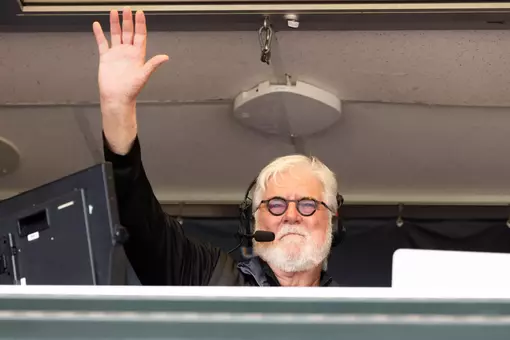
SAN LUIS OBISPO, Calif. – After more than 43 years with the San Francisco Giants, first as a player, then as a broadcaster, Mike Krukow said his goodbyes last Sunday at Oracle Park.
The former Cal Poly pitcher who won 20 games and was an All-Star in 1986 received a rousing sendoff from the more than 10,000 fans who remained at the stadium for the one-hour ceremony that followed the Giants' season-ending 5-1 loss to the Los Angeles Dodgers and also heard plenty of praise from various team dignitaries and former teammates.
Krukow played 14 seasons in the Major Leagues from 1976-89 -- six with the Chicago Cubs, one at Philadelphia and seven for the Giants -- before hanging up the cleats and entering the broadcast booth to embark upon a 36-year career behind the mic, most of them with Duane Kuiper as part of one of baseball's most iconic duos -- the Kruk and Kuip team.
Recruited by legendary college baseball coach Augie Garrido out of San Gabriel High School and a 32nd-round draft pick by the then-California Angels, Krukow chose to continue his baseball career at Cal Poly, arriving in the fall of 1970. At the time, he was projected to be a catcher for the Mustangs. The Angels listed him as a catcher-pitcher on the draft board.
"I thought that was a typographical error," Krukow said. "And when we started fall ball, the coaches didn't really declare as to what I was going to do. I had a pretty good idea of what he wanted to do. But I was hitting really well, .360, playing well and I was throwing guys out."
After playing about 45 fall ball games throughout California, Krukow had a meeting with Garrido, who went on to earn 1,975 wins at Cal Poly, Cal State Fullerton, Illinois and Texas and five College World Series titles. He retired in 2016 and passed away two years later.
"Augie called me in and he said, 'You're going to make the varsity.' I said, 'Fantastic.' He then says, 'You're going to be a pitcher.' And I said, 'I don't want to be a pitcher. I'm an everyday player.' And he goes, 'I don't understand that, but if you want to be on the varsity, you're going to be a pitcher. If you want any scholarship from me, you're going to be a pitcher.' So that was it," Krukow recalled.
" 'Look, you're not going to get to the big leagues with your bat, but you have a chance to go far with your arm. You have a good arm.' So that was it," Krukow added.
Krukow was 25-6 in his three seasons as a Mustang (1971-73) with a 1.94 ERA and 266 strikeouts over 265 2/3 innings. He earned All-California Collegiate Athletic Association honors in 1973, was an inaugural inductee in the Cal Poly Athletics Hall of Fame in 1987 and was inducted into the CCAA Hall of Fame in 2015.
"I learned more baseball from Augie Garrido than I learned from anybody," said Krukow. "I thought I knew baseball, but when you were around Augie, you quickly realized you're a little short of his expectation. That was the learning experience. It was intriguing going to practice because he demanded that we practice like we play. It really was a professional philosophy.
"In practice, you prepare as if you are in the game itself and in the discipline that it took to be able to hold your concentration, to have good working habits," Krukow added. "It was a great experience for me because a lot of what Augie was doing was professional philosophy. When I got into professional baseball, I felt I had an edge."
Krukow still holds the Cal Poly record for lowest career earned-run average at 1.94 and is tied for No. 1 with five career shutouts. His 21 career complete games is No. 4 and Krukow earned 10 complete games in 1973, tied for No. 3 on the list.
He is second with his 1.35 ERA in 1973 and No. 5 in career wins (25), career strikeouts (266) and strikeouts in a single season (123 in 1973), No. 4 in both career walks (149) and single-season walks (62 in 1972) and tied for No. 9 with his 10 wins in 1973.
After toiling in the minor leagues for the better part of four seasons with stops at Bradenton (Florida), Midland (Texas), Key West (Florida) and Wichita (Kansas), Krukow made his Major League debut on Sept. 6, 1976, against the New York Mets. The third of six Chicago pitchers in the game, the 24-year-old allowed three runs and three hits over 2 1/3 innings with one walk and no strikeouts. New York won the game 7-4 as Jerry Koosman went the distance for the 18th of his 21 victories that year.
Following the 1981 season, Krukow was traded to the Phillies for Keith Moreland, Dickie Noles and Dan Larson. He was 13-11 with a 3.12 ERA in his lone season at Philadelphia before he was traded again, this time stopping at San Francisco. Krukow and Mark Davis swapped places with Al Holland, Joe Morgan and C.L. Penigar.
Krukow was 30-34 in his first three seasons in the Bay Area before his breakthrough 1986 campaign. He was 20-9 with a 3.05 ERA and 10 complete games (two shutouts) en route to a spot on the National League All-Star Team, pitching a scoreless ninth inning. Krukow finished third in Cy Young Award voting behind Mike Scott and Fernando Valenzuela and was the first Giant to win 20 games in 17 years, finishing off the feat in the final game of the season at Dodger Stadium.
"Getting traded to the Giants is the greatest thing that ever happened to me," said Krukow. "I wasn't happy to get traded to the Giants because I knew (Philadelphia) had a good team coming back. There was an article in the offseason that said there were four untouchables on the Phillies team -- Mike Schmidt, Steve Carlton, Ivan de Jesus and me. And the next day I was traded to the Giants.
There were just five 20-game winners in 1986 -- Roger Clemens with 24, Jack Morris and Fernando Valenzuela with 21 each, and Krukow and Teddy Higuera, both with 20. Also that season, Krukow was ninth in the National League in strikeouts (178), fourth in complete games (10), eighth in ERA and fifth in shutouts.
Krukow retired from baseball in 1990 after pitching in just eight games during the 1989 season, suffering a season- and career-ending torn rotator cuff injury on June 11. He finished his career with a 124-117 record and a 3.90 ERA in 369 Major League games with the Cubs, Phillies and Giants.
Krukow returned to San Luis Obispo and entered the restaurant business with former Mustang catcher Doug Redican. At the same time, he began his broadcasting career on a part-time basis with the Giants, taking over full-time duties behind the mic in 1994.
"When I retired, Roger Craig offered me the pitching coach job and he said, 'I'll teach you how to be a manager.' And I thought long and hard. I didn't answer him for a week. Finally, I wrote him a letter and I said, 'Roger, I can't do it. Jennifer (his wife) is pregnant. I've got four kids and she's due in December. I have to stay home.' Jennifer had really kind of held the line for a lot of my career. It was time for me to be home."
One of Krukow's teammates at Cal Poly was catcher Robin Baggett, for whom the Mustangs' current baseball stadium is named. Baggett calls Krukow the team's prankster while Krukow labels Baggett as a sign thief.
"Back in the 1970s, all the athletes at Cal Poly on scholarship were living in the athletic dorms, Chase, Jesperson and Heron halls. We interacted every day with those from other sports. We all supported one another," said Krukow.
"We went to a football game and I go in the bathroom one day and you know the sanitary paper that covers the toilet seat? Well, I stole a whole box of them. I probably could have been expelled from Cal Poly for doing that. I get back up in the stands and I started handing these things out and they said, 'What do we do with these?' Put them on your head. Let's go. So everybody put the ass gasket on their head. It was hysterical and we laughed hard.
"Well, the next game, it grew and grew and grew. And pretty soon, the whole (east) side of the stadium was wearing an ass gasket. We had to go scour around the gas stations throughout the county to find more of them. There was no place to buy ass gaskets. I probably could have been arrested. We all had a fun time with it. We were the asses and the assets. That's what we called ourselves. We had a song and everything. It was hysterical," Krukow said.
"Mike was always the prankster," Baggett added. "We would confiscate most if not all the disposable toilet seat covers from San Luis Obispo’s public restrooms. Then anyone who entered the football stadium on the east side had to wear the 'ass gasket' over their head. That particular game was a sellout, and the entire east side of the stadium was covered in white."
Baggett developed a reputation for stealing the opposing team's signs.
"Baggett was the greatest sign thief I ever saw. That's every level I was ever at. He would have the signs from the opposing team by the third inning. And no matter what they tried to do, how they tried to change them, it didn't take him long to figure it out. I don't think I ever played with anybody that could steal signs like Robin. He just had a remarkable eye for it," said Krukow. "He was definitely one of the smartest players I ever played with. And he was never wrong. Nope."
Apparently, Krukow was good at stealing signs too.
"Mike was in charge of our pitching staff stealing the other teams’ signs," Baggett said. "By the third inning Mike had all the signs. That enabled me to call timely pitchouts when a runner was attempting to steal. Mike never failed me. He was the best and will always be the best. Mike was always Mr. Baseball, and he had great baseball instincts."
And the nicknames?
"Mike was in charge of giving everyone their nicknames," Baggett said. "Off our 1971 team and Cal Poly Hall of Famers, I was 'Bago', Kent Agler was 'Ago', Dave Oliver was 'Ollie', and Mike was and has always been 'Kruk'. And that’s how we all refer to each other today. Mike had a good nickname for most anything."
In his third season at Cal Poly (1973), Krukow was involved in one of the scariest plays in Mustang baseball history. At Cal State Northridge (then called San Fernando Valley State College), he was hit in the back of his head with a line drive off the bat of Chuck Mandel. The ball rolled to third baseman Greg Clark, who made the throw to first to get Mandel for the final out in the bottom of the fourth inning.
Krukow led off the top of the fifth and grounded out before he was removed from the game and taken to Good Samaritan hospital in Northridge.
CSUN won 7-1 on May 11, 1973, and went on to sweep the three-game series to clinch the CCAA title. Cal Poly entered the series needing two wins to clinch the CCAA title. Krukow struck out two and walked three in four innings on the mound, allowing five runs in the first three innings as CSUN jumped to a 5-0 lead and never looked back.
Though he was a pitcher at Cal Poly, Krukow hit four home runs in 1973, tied with Dan Marple and Larry Silveira for the team lead. He was 13-for-49 (.265) in 1973, 10-for-38 (.263) in 1972 and 3-for-13 (.231) in 1971, giving him a .260 career batting average as a Mustang (26-for-100).
"I loved every day of my experience at Cal Poly," said Krukow. "Much like a lot of people who went to Cal Poly say, when you get out of there, you want to figure out a way to get back. My wife, Jennifer, who also went to Cal Poly, and I built a house. We had five kids and we lived there for close to 25 years. It was just one of those very, very special places. Every day that we lived there, we woke up thinking, 'Damn it, I'm glad to be here.' I'm so lucky to have lived here."
Quotes from Sunday's Retirement Ceremony
Giants President Larry Baer:
Jackie Robinson once said, “Life is to be measured by the impact it has, by one's impact he or she has on other lives.” By that standard, Mike Krukow is second to none in Giants history. Mike. 43 years, 43 years as a Giant. You've carried the torch on the mound, in the booth. We all know, you are the 20-game winner, division champ, '87, World Series '89, inaugural Wall of Fame class, fierce competitor on the mound. We know your accomplishments in the booth. But above all, from the organization, every single person who has ever had a badge to walk in the doors of 24 Willie Mays Plaza or Candlestick Park, what we'll remember you most for is your authenticity, your bold authenticity, your love for your family, your love for all people, all people that worked in this ballpark, your love for the game, your love for the Giants, and your love for San Francisco.
• • • • •
Buster Posey (San Francisco's catcher on the 2010, 2012 and 2014 World Series championship teams and currently the Giants' president of baseball operations):
Kruk and Kuip are authentic. Their genuine friendship that has played out through the TV screens for multiple decades is certainly part of the magic. They're funny, they're smart, witty, and most definitely knowledgeable about the game of baseball. You two have a way of making Giants fans feel like they're part of something bigger than a baseball game. They make people feel like they're part of a community working toward a common goal. They, and all of us, have shared the highs and the lows, the triumphs and the defeats through their masterful storytelling. And I'm grateful for that. Both Kruk and Kuip have volunteered their time to help us raise money for childhood cancer. Also, Mike and Jennifer have posted events at their house over the years to raise money for the Northern Nevada Children's Cancer Foundation. One of the many attributes that I admire about Kruk is his compassion for those in need.
• • • • •
Bob Brenly (former player and manager of the Giants):
I'm going to tell you a real quick story about the first time I caught this guy in a big league game. He had come to the Giants in '83. I'm catching Mike Krukow against the San Diego Padres. Every sign I put down, he shook off. And it got worse. He would first just shake his head no. Then he'd shake his head no like this. Then he'd roll his eyes toward the heavens. And then eventually he would step off the mound. Why do I have to throw to this country bumpkin catcher? Who is this guy? Well, let me tell you how the first inning went. He walked the leadoff man. He got an out. Then he walked the number three hitter, which brought up Terry Kennedy, who hit a double, drove in two runs. Then he walked another batter. Then he finally struck out a man to end that first inning. We came to the plate in the bottom of the first and made three outs as fast as you could possibly imagine. So now I'm back behind the plate again. Hanging signs. First batter of the second inning reaches on an error by... The next batter hits a double. Now, this was the number eight hitter in the Padres lineup. So I got a new ball from the umpire and I walked out to the mound. And he's got his glove out waiting for the ball. And I spiked it in his glove as hard as I could. And I said, let's see if you can get the doggone pitcher out. And I went back behind the plate. Gave up a hit to the pitcher. Got another out. Then gave up a single and was pulled from the ball game. Now the reason I tell this story -- I think that was the moment that he made me believe that I was good enough to catch him.
• • • • •
For Giants fans, this is as close as a disaster as an earthquake, losing Mike Krukow on Giants telecast. But the feeling I have more than anything else is envy. I envy Duane Kuiper for getting to work with Mike Krukow all these years. And exactly the same way I envy Mike Krukow for having the opportunity with Duane Kuiper. I'm envious of you fans. You've had the treat of nearly four decades of listening to the best broadcast booth in all of baseball. Brenly also noted that he hit .224 in the 1983 season. Kuiper hit .250. Krukow hit .254. "He trumped us both."
• • • • •
Will Clark (former Giants player):
He is the career leader in ERA at Cal Poly. He won 124 games in the major leagues, played 14 years for three teams, seven years with the Giants. He played in 369 games. And as he gives a little dig to his partner right here, he had five homers and 54 RBIs as a career. In 1986, he was 20-9, he was our All-Star, and he had one of the most phenomenal years I got a chance to play behind. Just absolutely dealt the whole year. He is a two-time back-to-back Willie McCovey winner (the Giants' most inspirational player). That shows you how much he's respected with the Giants, dugout and clubhouse. He took myself, Robbie Thompson, and other rookies down the line, Matt Williams, Kurt Manwaring, and they all listened to everything he said. That's how we became big leaguers, and that's how we turned this organization around.
• • • • •
Daniel Lurie (San Francisco mayor):
This is a joyous occasion because for more than three decades, San Francisco got to listen to the two of you, the two best to ever do it. We got Barry Bonds' 756, we got Matt Cain's perfect game, we got three world championships, and through it all, we got Kruk and Kuip. These two have been the voices for generations of Giants fans. We listen to them in our cars, we listen to them in our homes, we listen to them with our parents, and then years later, we listen to them with our kids. And somehow, it never really felt like they were broadcasting to us. It felt like they were sitting there talking with us. They made an entire city, an entire region, feel like their teammates. Kruk and Kuip, you two have called some of the biggest moments in Giants history, but you also have become part of that history. And I'll join the growing chorus saying that when Cooperstown comes calling, as they should, and as we know they will, you should go in together. I'm going to do something that I have never done as mayor, and I can't think of two people that I'd rather give them to. Mike Krukow and Duane Kuiper, it is my honor and privilege to present you both keys to the city and county of San Francisco. If either of you shows up at City Hall, I want to make sure you can get in.
Mike Krukow:
I didn’t know these things were real. So this means we can park anywhere we want, right? Perfect!
• • • • •
Duane Kuiper:
I want to start by going back to the year that Mike was diagnosed with this horrible disease (inclusion body myositis, a degenerative muscle disease), which was around 2007. I kept thinking, what if on that day that he's diagnosed, he doesn't broadcast anymore? Well, we had him for an extra 20 years. And those 20 years for him were not easy. We used to watch him try to get on and off an airplane, almost impossible to do, given his condition. But he pulled it off and never complained. What I got out of this, and the mayor mentioned it, if Mike misses those 20 years, think about the most important three years in this franchise's history. He misses not one World Series, not two, but he misses three. And we had him for all of them. Since he made the announcement to retire (about six weeks earlier), even though it's slightly sad, I don't think I've ever seen him happier because finally he could make this decision on what he wanted to do. And he certainly has done it.
And taking a page from Jim Valvano's infamous "Don't ever give up" speech," Kuiper said of Krukow, "He makes me laugh, he makes me cry, he makes me think, and now today he really does make me cry. I love you, brother.”
I will miss his 100 percent effort for the perfect day. His ability to make people feel good. It is such a talent. I'll miss Mike being what he really should have been. And that's a teacher. He would have been everybody's most favorite teacher. I've seen him teach kids in our booth how to shake hands. I've seen him take our number one draft pick and show them how to hold the ball different to make this ball move. And on the golf course, forget it. I mean, he's a teacher on every hole. There's no doubt that he would have been a fabulous teacher.
• • • • •
Mike Krukow:
Krukow's long list of people he thanked included "my incredible partners, Jon Miller and Dave Fleming, whose talent and love for the game have been inspiring. They welcomed Duane and me into the broadcast booth to join with them and tell the historical playoff runs in the greatest era in San Francisco Giants history. The games we did together are the moments that we are most proud of as broadcasters."
My wife, Jennifer. When we were in high school together in 1970, I was a senior, she was a little junior, and every day after lunch she would walk me to my English class. Then one day I reached out and I held her hand, and she looked up at me and she winked. And that was it. I never let her hand go. Thank you, baby.
And to my dear friend, Duane Kuiper. The tough and stubborn Dutchman from Racine, Wisconsin, who when we were teammates, I couldn't wait to get to the yard and suit it up with him. His intensity as a player, and his ability to find humor in the day-to-day pressure of the big leagues was enlightening."
Krukow and Kuiper were teammates with the Giants for three seasons (1983-85). "As players, we would do mock broadcasts, sitting in the dugouts. And when our baseball careers had ended, we were blessed to have been able to do it for real. Our partnership has lasted 36 years, and our sides still ache from all the laughs."
Aside from the memorable San Francisco moments noted earlier in the ceremony, Krukow reminded the more than 10,000 fans who remained in the ballpark after the team's 10-inning 5-1 loss to the Los Angeles Dodgers what Giants baseball is all about.
“We have booed the Crazy Crab, we’ve endured the torture, we’ve feared the beard,” Krukow said. “We have laughed at the rubber chickens, the ugly finders, the shin burgers, the pea rods and the magic wandoos. We have cheered the splash hits, we have loved our ball dudes, we have bragged about our gamer babes — you never let me down — and we have enjoyed the Jung Hooligans, and we have cringed every time they have changed the name of our beautiful stadium.
“We’ve given each other knuckles and high fives and game faces and Buster hugs and stank eye and … we have pleaded for them to let Pablo eat, pitch to Barry, and let Timmy smoke. And we have watched our players get Oracled, Cained, and they break out a new version of the pop-up dance every day. We have found out that Hunter Pence eats pizza with a fork, can’t parallel park, still uses a night light, and he thinks Crocs are stylish. We wore Madbum underwear and we were ordered to keep calm and just Panik. We love our foghorn, McCovey Cove and the great big baseball mitt in left field.
“This is who we are and we are not making apologies forever. It’s Giants baseball. And it was given to us by someone we loved and it is what we are going to give our children and in turn, they will someday pass it on to theirs.”
Three of Krukow's children, Tessa, Wes and Chase, sang the national anthem prior to the first pitch Sunday and also sang “The Parting Glass" at the end of the postgame ceremony.
• • • • •
Ford C. Frick Award:
Krukow has been a finalist for the Ford C. Frick Award four times, while Kuiper has been up for the award five times. Both will be eligible for the award, presented by the Baseball Hall of Fame for excellence in baseball broadcasting, in 2027.
Under current rules, Krukow and Kuiper would have to be elected as individuals, not as a tandem. In 1978, Mel Allen and Red Barber were the first two recipients of the inaugural Ford C. Frick Award. Since then, only one broadcaster has been elected every year for the last 48 years.
The Hall of Fame rarely makes exceptions, but a loud majority wants to see Kruk and Kuip be elected together. That includes the legendary Bob Costas.
Costas, the 2018 Ford C. Frick winner, said many members of the current committee are in favor of Krukow and Kuiper going on the ballot together, but “the Hall, for some reason, hasn’t allowed that to happen yet.” In Costas’ estimation, if Krukow and Kuiper go on the ballot together, they’ll eventually be elected.
“Next year in Cooperstown, Krukow and Kuiper should be standing together. It’s long overdue,” said Brian Anderson, the Milwaukee Brewers broadcaster who has also been a finalist. “I think the Hall of Fame needs to make some sort of an adjustment or an amendment because they are exactly what the definition of a Hall of Fame broadcaster would be. Everything that Ford Frick stands for, that’s what they are, and that’s what we all strive to be.”
Added Mark "Mud" Grant, a color commentator for the San Diego Padres: “I respect everything about the Hall of Fame, and I’m all about the rules, but there are certain things in sports that are a no-brainer.”
Support Cal Poly Baseball through Project Omaha and help fund scholarships and holistic student-athlete support, ensuring the program has the resources to compete at the highest level amid the evolving landscape of college athletics, including the NCAA’s increase to 34 full scholarships. Donations directly support student-athletes, helping attract and retain elite talent while upholding academic excellence. As part of the initiative, a matching fund specific to Project Omaha has been established by the University, providing permanent investment into the program’s operational budget and further strengthening Cal Poly Baseball’s competitive foundation.
Make your impact today by supporting Project Omaha, powered by Players Edge.